Freitag, 23. September 2016

Origami Butterfly Fun


I love butterflies. In origami they are very grateful to fold and design giving the world a little bit more color. On the left two of my older designs that are unlike any other butterfly design. The remaining four developed recently after I gave a small workshop on my simple but elegant model (butterfly 1) on which they are based.

Dienstag, 2. August 2016

Die tollsten Insektenarten aus Ungarn (und zwei unidentifizierte Pflanzenarten)


In Juni war ich auf Entdeckungsreise in Ost-Ungarn und habe dabei jede Menge (für uns) besondere Insekten gesehen. Hier eine kleine Liste und paar Fotos von Arten die ich im kurzen Zeitraum von nur 2 Wochen entdecken konnte.

Die größten Europäischen Käferarten:


Hischkäfer - Lucanus cervus


Großer Eichenbock - Cerambyx cerdo

sowie
Balkenschröter (kleiner Hischkäfer) - Dorcus parallelipipedus
Nashornkäfer - Oryctes nasicornis
Walker (Julikäfer) - Polyphylla fullo
Gelbrand - Dytiscus sp./Cybister sp. - (Larve in einem Teich)


Der große Eichenbock - Cerambyx cerdo haben wir im Stadtzentrum von Szeged gefunden, auf nur einen bestimmten alte Eiche. Die andere 30 Eichen waren  nicht betroffen und somit gibt es noch Potential für diese Art um hier weiter zu überleben. Die Käfer wählen nur Eichen ab 100 Jahre alt aus. Die Art ist so bedroht weil sie eine sog. 'kritische Verbunddistanz' von 2 Km hat, und ohne große Eichenwälder nur in isolierten Populationen leben kann.


Biotop Bergwald mit alten Eichen:


Schwalbenschwanz - Papilio machaon,
sowie Segelfalter - Iphiclides podalirius


Großer Waldportier - Hipparchia fagi (hier auf der Suche nach Salze :)


Kaisermantel - Argynnis paphia

sowie:
Großer Schillerfalter  - Apatura Iris
Kleiner Eisvogel - Limenitis/Ladoga camilla
Roter Buntkurzflügler - Oxyporus rufus
Kleiner Leuchtkäfer - Lamprohiza splendidula
Haselnussbohrer - Curculio nucum
Bergzikade - Cicadetta montana


Biotop Flußaue:


Pfaendlers Grabschrecke - Tridactylus pfaendleri - lebt am Ufer


Gefleckte Ameisenjungfer - Euroleon nostras


Schwarzbrauner Trauerfalter - Neptis sappho - für mich ein Highlight am letzten Tag!


Sonstige interessante Arten:

Weißfleckwidderchen - Syntomis phegea - kam massenweise vor im Wald


Dornen-Randwanze - Philomorpha laciniata


Unbekannte Krabbenspinne  - Synaema sp. - mit einer Schwebfliege als Beute

Matter Pillendreher - Sisyphus schaefferi
Blatthornkäfer - Mimela aurata
Großer Fuchs - Nymphalis polychloros
Resedaweißling - Pontia edusa
Verschiedene Perlmutfalter
Taubenschwänzchen - Macroglossum stellatarum
Hornissenglasflügler  - Sesia apiformis, und andere Sesiidae


Und zum Schluss, zwei spannende unidentifizierte Pflanzen:


Wer sie kennt bitte ein Kommentar hinterlassen!
Edit: Rechts ist die schopfige Traubenhyazinthe (Muscari comosum). Eine ähnliche Art ist die  schmalblütige Traubenhyazinthe (Muscari tenuiflorum), welche in Deutschland nur auf den trockenen Kalkmagerrasen Thüringens vorkommt.


Freitag, 29. Juli 2016

Microsoft gegen Muslime, oder die Macht über unsere Gedanken?

Ein Denkanstoß. Heute haben Millionen von Deutsche "Muslime gehören hier einfach nicht hin" wiederholt auf ihrem Bildschirm gesehen. Zufall? Nein. Die Standardeinstellungen von Windows 10 zeigen die Nachrichten auf einer der Live-Kacheln, jedes mal wenn man über das Startmenü eine Anwendung öffnen möchte. Es ist kein Geheimnis das Microsoft rechts orientierte Partner hat, und so auch der Nachrichten-Kachel überdurchschnittlich oft rechte Schlagzeilen zeigt. Und so kam es das heute "Muslime gehören hier einfach nicht hin" gezeigt wurde (als Zitat), und jeder mit Windows 10 und Standardeinstellungen das wiederholt gelesen hat, bewusst oder unbewusst. Und so funktioniert die Macht des Superkonzerns mir Windows 10. Neue Elemente in Windows 10 sind einfach da und beeinflussen dich! Eine Lösung gibt es glücklicherweise. Bald zeige ich euch in einem Post wie man diese Sachen ausschalten kann und wie man Windows 10 einrichtet. Heute war ich einfach schockiert über wie stark der Einfluss eigentlich ist. Natürlich wird man im Supermarkt am Zeitungsregal die verschiedene Schlagzeilen auch ausgesetz. Aber halt von verschiedene Zeitungen und nicht mehrmals täglich. In Windows diese Art von Werbung und Beeinflussung zu haben ist neu und im Ausmaß ungekannt und das sollen wir und bewusst sein. Der Preis für gratis Windows 10 ist die Macht über dein denken (das gilt sogar für preiswert gekaufte Lizenzen, halt für alle). Und Microsoft ist ja leider nur einer von vielen die uns beeinflussen. Wir müssen uns selbst mehr aktiv machen um die Macht über unser eigenes Denken zu behalten! Man denkt was man konsumiert...

Ach ja, dann nochmal: "wer aus Angst geflüchtet ist, auch ein Muslim, verdient Hilfe, weil wir Menschen untereinander sind, auch wenn der Andere eine Religion hat die wir nicht verstehen." Nur mal um alternative Gedanken im Gehirn zu aktivieren.

Montag, 11. Juli 2016

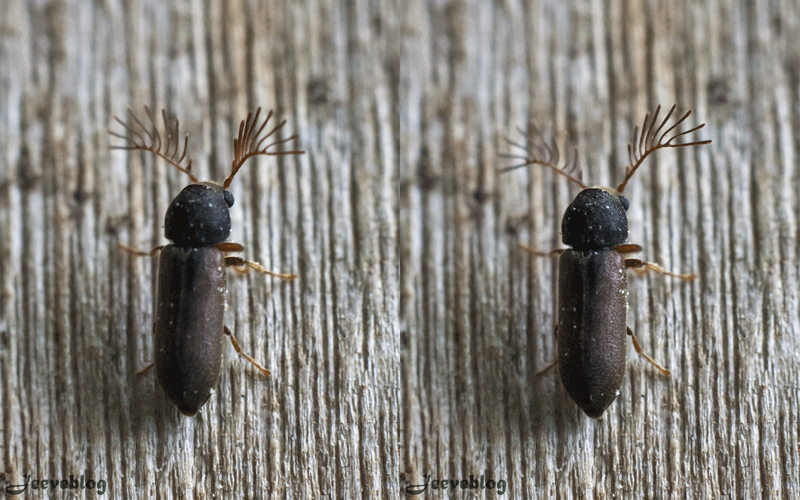
Freddy the dancing beetle

Today is celebration time with 
Freddy the dancing beetle!


Two pictures of Ptilinus fuscus,
merged in Photoshop.

Sonntag, 12. Juni 2016

Obstfliegen loswerden - Das beste Rezept

Obstfliegen Mischung

Jedes Jahr kommen sie wieder in große Zahlen und versauen die schöne Zeit in der Küche: Obstfliegen. Mit dieses Rezept, basierend auf viele andere Rezepte aus dem Netz und einige eigene Experimente, werden sie angelockt und ertrinken. Die Mischung am besten auf einem flachen
Teller(chen) zusammen-mischen und irgendwo in der Küche hinstellen.

Hier kommt die Basis:
1 Tl Zucker
2 Tl Balsamico-Essig
1 Tl Zitronensaft
ein Schuss Wasser
ein Tropfen Spülmittel

Gut rühren bis der Zucker gelöst ist. Das Spülmittel bricht die Oberflächenspannung, wodurch die Fliegen direkt ertrinken.Viele Varianten sind möglich. Zucker kann man austauschen gegen Fruchtsirup, Zitronensaft gegen ein zweiter Tropfen Spülmittel wenn dieses stark nach Zitrone riecht, usw. Auch Weißweinessig und Gurkenwasser sind beliebt.

Historical image restoration - Reparatur von alte Bilder


Ich habe meine Seite mit der digitale Restaurierung alter Bilder erneuert und eine Liste mit Reparatur-Dienstleistungen hinzugefügt.


Mein Interesse für historische Fotos und deren Restaurierung hat mit dieses Bild von meinem Großvater auf dem Motor angefangen. Seitdem habe ich einiges dazu gelernt, und probiere ich regelmäßig neue Techniken aus, aus dem Buch "DIGITAL RESTORATION From Start to Finish".


Dieses Bild zeigt mein anderer Großvater als Kind (Mitte), seine Eltern (links und rechts) und seine Geschwister (oben). Auf 100% ist gut zu sehen wie gut Kratzer und Flecken zu entfernen sind ohne das Detail verloren geht.

 
Aus der gleiche Familie ein Bild, welches zeigt das auch Risse gut repariert werden können.


Zum Schluss noch ein Bild vom Vater des Motorfahrers aus dem ersten Bild. Extreme Verblassungen können meistens restauriert werden.

Montag, 16. Mai 2016

Mercury transit - We, the Earth, the Sun, and the planets between us

Imagine that you are waiting in your car for someone, and suddenly a fly walks over the front window. You see the fly, but also a building in the background. It seems like a giant fly that is walking over this building with doors and windows. You imagine that? We could call this a 'fly transit'. Now imagine that the front window is 5 meters away from you. You still see the fly walking over the building but it looks pretty small.
The first situation symbolizes the Venus transit, and the second the Mercury transit because Venus is much closer to Earth than Mercury. The big difference is that these planets do not walk over a window. They just seem to hang in space and turn around the Sun. They have a little higher velocity, but much shorter paths around the Sun (orbits). This is why they turn in fewer days around the Sun, and we can see them moving across the Sun from time to time. Wow! Imagine Earth, Venus and the Sun 'hanging' in space and turning around each other. The gravity of the Sun is the only thing preventing us from floating away! These transits are a beautiful and visible proof that we, and other planets, turn around the Sun.


Mercury transit 2016 (May 9)
The big spot is a sunspot and stays where it is. The second -very small- dot is Mercury and moves between these three photos that I took during the several hours of the transit from middle left to lower right. Mercury transits occur quite often (13-14 times a century), but due to different angle of the orbit path, it can also pass the earth without moving between us and the sun (higher or lower). The next transits are in 2019 and 2032. Mercury moves with about 50 km/s around the sun in 88 Days (Earth: 30 km/s in 365 days). It is about 60 million km from the Sun (but varying because of an elliptic path) and about 77 million km from Earth . It is also quite small, roughly 5000 km in diameter compared to Earth with 13000 km.


Venus transit 2004 (June 8)
I took this series with my analog equipment in 2004. Venus appears much bigger than Mercury, just like the fly on the window direct in front of you. I was lucky to observe it so nicely! The 2012 Venus transit was badly visible due to clouds and for the next one we have to wait until 2117 and 2125. Venus transits occur in pairs with 8 years distance, because 13 Venus turns around the Sun is almost exactly 8 Earth turns. 8 Years later, they miss each other because Venus is slightly too fast and orbit tracks have a different angle. In the last picture the 'black drop effect' can be seen: Venus and the Sun visually merge together, instead of two circles perfectly laying on top of each other. This effect was long thought to be linked to Venus' atmosphere, but in 2004 so many picture were be taken around the world that this effect is now thought to be caused by irregularities in the earth's atmosphere and by lower quality optics. Remember that the previous transits were in 1874 and in 1882 and the first few picture were taken! Without knowing, one of the photographers back than, Jules Janssen, wrote history by making the first 'movie'. In 1874 he made a series of Venus transit photos on a wheel, just like the first stop-motion pictures with moving animals made by Eadweard Muybridge in 1878. Notice that they were both scientists trying to documents something very accurately.
Venus moves with about 35 km/s around the sun in 225 Days (Earth: 30 km/s in 365 days). It is about 108 million km from the Sun and about 38 million km from Earth (closest distance, at transit). It is just a little smaller than Earth, roughly 12000 km in diameter (Earth: 13000). For who wants to know: Mercury and Venus can transit the sun at the same time, but this happens not so often, the next time is in the year 69163.

Science and transits
The early observations of Venus transits in 1639, 1761, 1769,1874 and 1882 were used to estimate the distance between Earth and Venus and to the Sun (by solar parallax). If you observe the transit from the northern hemisphere and the southern hemisphere (with a known distance between these points), both transits appear slightly moved up and down to each other on the sun, but measuring this vertical shift appeared to be too inaccurate. The following step was to measure the exact time between start and end of the transits, which is shorter when the transit is lower on the sun. This served a more accurate estimation of the distance between both paths. However, the start and end time were still inaccurate because of the 'black drop effect' in the observation.
The Venus transit of 2012 was used to observe how light properties change when a planet moves in front of the sun. This data is useful to improve the search for exoplanets. Exoplanets are mainly found by looking at stars and changes in the light of stars ("a big planet now moves in front of the star").


Viewing
There are only two safe ways to observe this phenomenon yourself; with approved eclipse glasses directly or by projection on a cardboard. Everything else can damage your eyes! Don 't look into the Sun directly! Sunglasses and welding masks are not safe, neither are the combination of eclipse glasses and binoculars.

Photography
For the pictures of Mercury I used my Canon EOS 7D, a Canon EF 75-300 (1:4-5.6 III) Zoom lens and a Kenko Teleplus 1.4x converter, making 420 mm in total. I used cheap Lumifol foil in two layers to darken the sun. This is a kind of reflecting foil which has microscopic holes in it, reducing the light substantially. This foil is not safe for viewing, since it has no additional layer reflecting UV and IR waves. So I never used the viewfinder for viewing during, but used the locked up mirror instead. The result is, despite tripod and locked up mirror, not perfect. At the same time still satisfying.
NASA can do better, of course
https://www.youtube.com/watch?v=AhWMOkrzKzs