Sonntag, 5. November 2023
Montag, 9. Oktober 2023
Climate change and insect declines were worrying ecologists long ago - 1850-1900
Since various studies have suggested that insect biomass has declined about 75% in recent decades, one could say that there were four times as many insects. Large biomass losses also occurred in the time earlier (agricultural revolution, as e.g. described in Rachel Carlson's book 'Silent Spring'). The 75% loss refers to the latest decades only. How many insects were there around 1900 or before? Why is there so little data?
Klimaerwärmung und Insektensterben waren lange her bereits besorgniserregend für Ökologen - 1850-1900
Seit verschiedene Studien nahegelegt haben das in den letzten Jahrzehnten 75% der Biomasse der Insekten zurückgegangen ist, kann man im Umkehrschluss sagen das es davor vier mal so viele Insekten gab. Große Verluste gab es in der Zeit davor auch schon (Agrarrevolution, wie z.B. beschrieben in Rachel Carlsons Buch 'Der stumme Frühling'). Der Verlust von 75% bezieht sich auf die letzte Phase. Wie viele Insekten gab es um 1900 oder davor? Warum gibt es so wenig Daten?
Mittwoch, 27. September 2023
Exposure stacking of a moonlit landscape - a challenge in Photoshop
You may have tried this yourself, trying to photograph a nice landscape with the moon during the twilight hours in the evening or morning. For a landscape like this you need a tripod and a long exposure time. The moon being many times brighter needs a very short exposure time. In cases with such brightness differences you normally make an exposure series as shown here (with tripod!) and use high dynamic range techniques and exposure stacking which is nowadays quite straightforward to use. However with the moon and a bright planet (Mars, or Venus) below the moon this does not work for several reasons:
- The long exposure gives 'stripes' for the stars, planets and the moon as well, because the earth moves
- Even more problematic for the same reason is that the moon, stars and palnet change position across the image between exposures
- The exposure difference is too extreme. Even stacking the cropped moon alone with over 10 images does not yield a nice image
As I will explain here, there is a 'dirty' solution to this problem, which is not as realistic as exposure stacking, but gives a result that is quite true to the experience of the viewer. In short: the washed out moon needs to be cleaned (and not as bright), as well as planets and stars visible as stripes. From the end of the exposure series you copy in a layer and set it to blend mode 'lighten'.
Sonntag, 2. Juli 2023
Advanced Photoshop technique for image restoration: remove erratic backgroud structures
This new Photoshop technique will allow you to remove any erratic, chaotic background patterns, caused by old printing machines ('random dotted pattern') or visible paper structures (fibers, depths), with the least possible blur. Note that there are various methods for recovering halftone prints from newspapers or color magazines (with the fast fourier transformation method) covered elsewhere. The images have in common that they show at the highest zoom a kind of chaotic leopard pattern. What you would like to do is to lighten the spots, and darken the background, so that they merge to a uniform color. The difficulty is to get a selection that is exactly right.
Dienstag, 2. August 2022
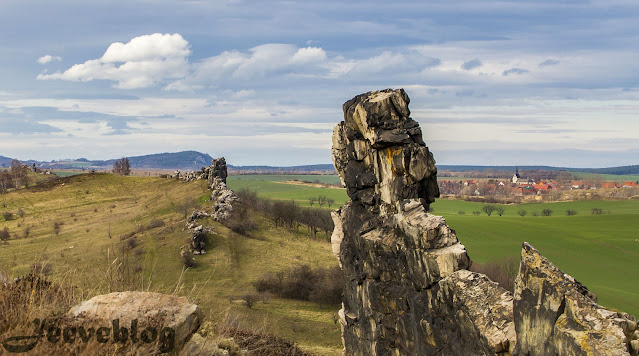
Die Teufelsmauer - ein einzigartiger Geotop und vergessene Perle am Harzrand - mit Karte
Die Teufelsmauer in Sachsen-Anhalt liegt am Ostrand des Harzes. Sie ist eine vergessene Perle, für Wanderfreunde die skurrile Felsformationen lieben. Manche kennen die Teufelsmauer bei Neinstedt, den bekanntesten Teil. Was viele nicht wissen, ist das die Teufelsmauer sich in 3 Teile über 20 km ausstreckt. An jeder diese 3 Orte kann man jeweils eine größere oder mehrere kleinere Wanderungen machen. Für unsere Familie hat sich dieser Gegend als sehr praktisch für kleinere Kinder herausgestellt, da die Strecken kurz sind und es viele Einkehrmöglichkeiten gibt: wenn man zurück läuft, sehen die Hinterseiten der Felsen nochmal komplett anders aus. Langweilig wird es, trotz wenige Kilometern, nie.
Freitag, 22. Juli 2022
The mystery of the dark rainbow
Many years ago I saw a "dark rainbow". A perfect bow, a dark curved band in the air, the same width and same shape as a normal rainbow. It was appearing in the south, where the dim sun also appeared, around 11:00 am. Later that day, my social network confirmed that others had seen this mysterious phenomenon as well. Mysterious indeed; nobody knew what it was or what could be the physical explanation! I contacted several meteorologists by email, but I never received an answer. All those years, none of the meteorological books that came in my hands provided a even the smallest clue... What could it have been?!!
Lego einfach reinigen
Mittwoch, 22. September 2021
Worterfindungen 2020
Nach langer Zeit habe ich unser Whiteboard in der Küche mal komplett sauber gemacht, und dabei zwei Worterfindungen aus 2020 weggewischt, die ihre eigene Geschichte haben.
Montag, 1. März 2021
Amazing photos of melting glaciers and mountain summits in the Italian Alps
Left image: SLUB / Deutsche Fotothek / Möbius, Walter; Right image: J. Everaars
When I visited the Italian Alps for a scientific project on the effect of climate and land use change on pollinators, I tried to re-picture some of the sites I found on historical photos. Here are some of the results.
Dienstag, 23. Februar 2021
Repairing - a broken computermouse
You're right - and you can fix it! It is just the wear of a part; a piece of metal that lost it's tension! I found this solution on this page by Nigel, who gets the credits:
http://www.redferret.net/?p=31008
This trick does not only safe money, it also safes electronic waste, and you can repeat it over and over again! I had to do it about twice a year, and it worked for about 6 times, extending the life of my mouse for three years!!! I found this so great that I decided to make a quick manual myself, to share with you.
Schmetterlinge aus Ahorn und Esche
Einfacher geht fast nicht; aus Ahornsamen und Samen von Esche und Zweige, lassen diese Schmetterlinge und Libellen sich leicht basteln.
Montag, 22. Februar 2021
Geburtstagsessen: Bienen, Käfer, Igel, Schnecken und Spinnen
Samstag, 6. Februar 2021
Riesenseifenblasen - aber dann umweltfreundlich bitte!
Samstag, 30. Januar 2021
Weihnachtssterne aus Pappelblätter

Die Anleitung hatte auf Englisch geschrieben und später als deutsche Version als Pdf illustriert. Ihr findet diese HIER.
Die Schritte sind einfach.
1. Blätter Sammeln und Trocknen
2. Sortieren in groß und klein und nach symmetrie
3. Der große Kreis aus 6 Blätter basteln
4. Der kleine Kreis aus 3 Blätter basteln
5. Der kleine Kreis auf dem großen Kreis kleben. Mit 2 Papierscheiben, 1x vorne und 1x hinten, geht das einfacher.
6. Aufhängen
Sonntag, 20. Dezember 2020
Photoshop filters for noise, color and sharpness
A. Film grain
B. Poor color
C. Focus problems
Samstag, 5. Dezember 2020
Handcrafting globes - with free software
When you like handcrafts and are fascinated by the earth and space, you probably imagine whether you could make a high quility globe out of cardboard, or even a lamp. The answer is yes, and you can do it even for free. Here I explain how. Some parts may seem difficult, but I encourage to try it.
Sonntag, 3. März 2019
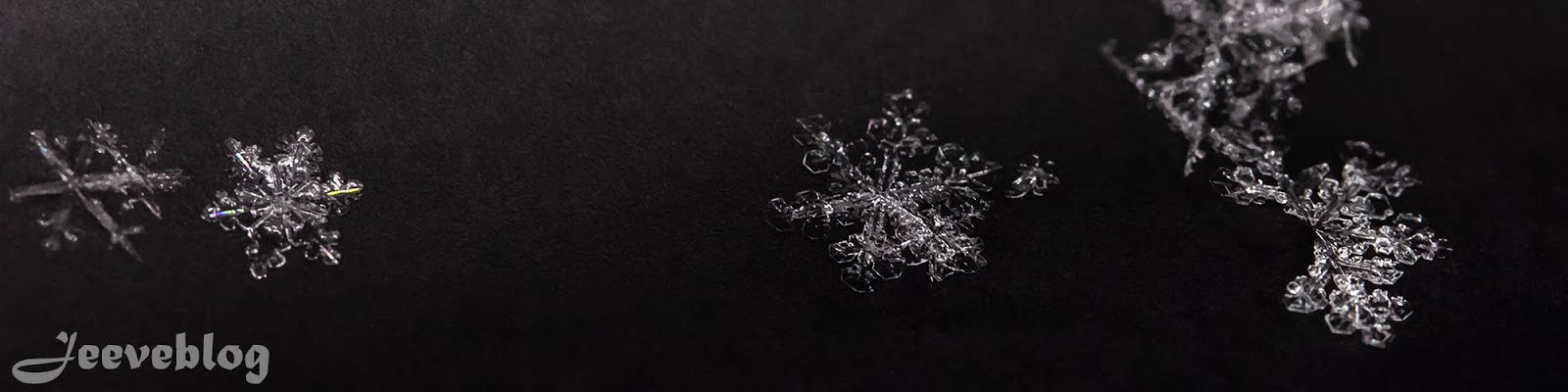
Snowflakes

Winter snow. A few weeks ago there was one of these not so common winter days; single well-developed snowflakes were falling from the sky, one by one, touching a snow-free surface.
My photographers hart started beating faster - this was a long awaited moment to make a series on snowflakes. A professional would have a prepared piece of black material (matted plastic) in the freezer waiting for this occasion. You need a very cold dark surface where the single snowflakes can land on. Now, I do not have a big freezer, so I have a different secret. I used black bicycle saddles, sufficiently available in our backyard. Further I used a Tamron macrolens (SP AF 60mm F/2.0 Di II Macro 1:1) and LED ringlight and some patience in Photoshop to clean up dirt from the saddles and increase contrast.
Enjoy.


Mittwoch, 2. Mai 2018
Species lists from different sources - how to synchronise names with the GBIF database in R
how to synchronize names with the GBIF database in R,
how to compile a list of Syrphidae from Switzerland and
how to determine which species are lacking in common identification keys

You may know this problem: you have 2 or more species list from different sources and they use different synonyms for the same species. You want to merge the lists to a single one that has only unique species. In this post you find:
- Getting species lists from books in to R
- Using R to compare these species list with the GBIF species database and merge them (including 'tricks', e.g. to extract names from a multidimensional list)
- Discussion of common problems to take in to account
- The final list of Syrphidae nicely formatted for printing
Case study description
The case study concerns European Hoverflies (Syrphidae). Unlike plants or mammals, this insect group has been subject to many synonymizations which results in very dissimilar name lists over time frames of a decade. I want to identify Syrphidae species from the Alps (mainly Switzerland), with two commonly used identification keys that do not include all alpine species. I need to know which species have to be identified with additional keys and which genera are safe to identify with the common keys. I took the species list of Switzerland from the website World of Syrphidae. For convenience and usability I also downloaded the German species list.
For Northwest Europe there are two recent major identification works:
The first covers (almost) all lowland species:
Van Veen, M. (2004) Hoverflies of Northwest Europe: identification keys to the Syrphidae. 256pp.
Van Veen published an addendum to his book on his website which enables identification of even more Syrphidae. I copied those species names manually into a txt file, an this list will be used as well.
The second work comes in two volumes and covers many alpine species:
Bartsch, H. et al. (2009) Blomflugor: Syrphinae. Nationalnyckeln till Sveriges flora och flora, DH53a. Artdatabanken, SLU, Uppsala. 406 pp.
Bartsch, H. et al. (2009) Blomflugor: Eristalinae & Microdontinae. Nationalnyckeln till Sveriges flora och flora, DH 53b. Artdatabanken, SLU, Uppsala. 478pp.
1. Getting the species lists from books and web pages into R
When you get experienced with this, it is faster than typing every single species manually.
- Scan the species list from your book, either with a modern copy machine or flatbed scanner (A digital camera often yield too strong distorted images that do not give a good text recognition.)
- Get a good text recognition (OCR, optical character recognition). I prefer to do a good OCR with Acrobat pro on a pdf made from the scans. There is also free OCR software that can do a good job on tiff and bmp images (here some software suggestions to try).
- For a good result, make sure that you have one column with species on your input. If you have e.g. 2 columns on a single page or printed 2 pages on a single pdf page, you have to edit the images a bit. For a pdf you can do the following. Crop your pdf to the left side first and export as tiff image. Rename from filename.* to filename_A.* (you can do this with e.g. total commander under Files -> multi-rename tool). Crop your pdf to right side and export as tiff images. Rename from filename.* to filename_B.* Now combine files to pdf again. You now should have a single list of species per page.
- Perform the OCR. Either export to text (save as other, txt (accessible), or select parts of the list manually and copy it into a *.txt file.
- Clean up the file. Keep a list of what to "find and replace": e.g. / must be l.
- Import the text file to excel or libre office calc. The delimiter is space. First 2 columns are genus and species. The rest may be rubbish or things like authority or common name and may be deleted. If you like to keep any of this (for example authority) you can do the following. Select all remaining columns (except genus/species), paste into a txt file, put behind the authority a sign for separation, instead of a space. In my example I had the kind of format: "Authority - Name". I replaced " - " by "-" to get a nice separation without spaces. Import and choose delimiter like "-".
Everything should now be in a perfect table! Scan through for further OCR errors, remaining ones can be identified in R. For use in R, I named the columns "GenSpec" for the species name, "FullGenSpec" for the species with authority, and "Gen" and "Spec" for using both elements separately.
2. Using R to compare species list with the GBIF database
Start and read the files with species lists:
################################_ ### Load packages and functions, set working directory #### ################################_ setwd("C://.../specieslistsR") #install.packages("taxize") #install.packages("dplyr") require(taxize) #for connecting to gbif species lists require(dplyr) #for bind_rows # a nice function for removing accidential spaces at end of species name trimendspace <- function (x) sub("\\s+$", "", x) ################################_ ### Read files #### ################################_ #DATAFILES list_vV <- read.table ("VanVeen_species_list.txt",na.strings="NA",head=T,sep="\t", dec=",", encoding = "utf-8") #encoding is relevant when OCR on scanned documents was performed head(list_vV) for (i in c(1:5)) {list_vV[,i] <- trimendspace(as.character(list_vV[,i]))} list_vVadd <- read.table ("vanVeen_Addendum.txt",na.strings="NA",head=T,sep="\t", dec=",", encoding = "utf-8") head(list_vVadd) for (i in c(1:1)) {list_vVadd[,i] <- trimendspace(as.character(list_vVadd[,i]))} list_Ba <- read.table ("Bartsch_species_list.txt",na.strings="NA",head=T,sep="\t", dec=",", encoding = "utf-8") head(list_Ba) for (i in c(1:5)) {list_Ba[,i] <- trimendspace(as.character(list_Ba[,i]))} list_CH <- read.table ("checklist_CH.txt",na.strings="NA",head=T,sep="\t", dec=",", encoding = "utf-8") head(list_CH) for (i in c(1:3)) {list_CH[,i] <- trimendspace(as.character(list_CH[,i]))} list_DE <- read.table ("checklist_DE.txt",na.strings="NA",head=T,sep="\t", dec=",", encoding = "utf-8") head(list_DE) for (i in c(1:5)) {list_DE[,i] <- trimendspace(as.character(list_DE[,i]))}
Two functions - the heart of the code:
#function for consulting Gbif and putting the right information in a dataframe
#with the species list copied to 'Gbifask'
func.GbifQuery <<- function()
{
#get current status for a list of species from gbif
listOfResults <<- get_gbifid_(Gbifask)
cat("\n", file = "gbifunknown.txt", append = F) #File for species names without retuns; F: clean file
#put data in dataframe
for (i in c(1:length(specieslist)))
{
if(i==1) # first entry used to start new dataframe
{
#first entry is the exact match if any present
#Gbifid <- listOfResults[[i]][1,]
listOfResults[[i]][,"enteredname"] <<- names(listOfResults[i])
Gbifid <<- listOfResults[[i]]
} else # second an further are added to dataframe by bindrows
{
if(length(listOfResults[[i]][])>0) # all valid entries
{
listOfResults[[i]][,"enteredname"] <<- names(listOfResults[i])
Gbifid <<- bind_rows(Gbifid, listOfResults[[i]])
} else # species unknown to gbif, write to file diectly
{
cat("\n", names(listOfResults[i]) ,file = "gbifunknown.txt", append = T)
}
}
}
}
#function for corrections with synonym lists
func.correctlists <<- function() {
speciescorrect <<- 0
for (i in c(1:nrow(CorrectionList))) #go through list with synonyms
{
for (Listname in ToCorrect) #go through series of lists to correct
{
Specieslist <<- get(paste(Listname))
speciescorrect <<- as.character(CorrectionList[i, "OldGenSpec"])
if(length(Specieslist[Specieslist$GenSpec==speciescorrect, "GenSpec"])>0)
{
#first save old name
if(correctiontype=="Synonym")
{Specieslist[Specieslist$GenSpec==speciescorrect, "SynSpec"] <<- as.character(CorrectionList[i, "OldGenSpec"])}
#than replace
Specieslist[Specieslist$GenSpec==speciescorrect, "GenSpec"] <<- as.character(CorrectionList[i, "NewGenSpec"])
}
assign(paste(Listname), Specieslist, inherits = TRUE)
}
}
}
Merge the species lists:
#Merge the species lists
speciesbind <- bind_rows(list_vV, list_vVadd, list_Ba, list_CH, list_DE)
speciesbind <- speciesbind[order(speciesbind$GenSpec),]
#remove duplicates
#which full species names (with authority) are duplicated?
speciesauthoritiesduplicated <- speciesbind[duplicated(speciesbind$FullGenSpec),"FullGenSpec"]
#remove them
set1 <- speciesbind[-which(speciesbind$FullGenSpec %in% speciesauthoritiesduplicated),]
#check what remains:
speciesduplicated <- set1[duplicated(set1$GenSpec),"GenSpec"]
set1[which(set1$GenSpec %in% speciesduplicated),"FullGenSpec" ]
Look at the saved table. Slightly different spelled authority names can be dismissed, clearly different authority names need to be retained.
Consult the GBIF database with the raw species list:
#make the species list. In our case all duplicates were Authority spelling variations
specieslist <- unique(speciesbind$GenSpec)
#Now find the synonyms
Gbifask <- specieslist
func.GbifQuery() #returns Gbifid
First get a list of typos:
# which entry has no exact match?
# get list of entries which have an exact match
matchingnames <- Gbifid[Gbifid$matchtype=="EXACT", ]
matchingnameslist <- matchingnames[,c("enteredname")]
#get a list of entries which have a fuzzy match
unresolvednames <- Gbifid[Gbifid$matchtype=="FUZZY", ]
#reduce the fuzzy list; filter out entries that also have an exact match
unresolvednames <- unresolvednames[-which(unresolvednames$enteredname %in% matchingnameslist), ]
#save this list, these are possible typos making them unrecognizable for GBIF
namestosave <- unresolvednames[,c("enteredname", "scientificname", "canonicalname","species","matchtype")]
write.table(namestosave, "possibletypos.txt", row.names = FALSE, col.names = TRUE, sep = "\t", dec=".")
- Open the saved file in a spreadsheet program, with the goal to make make a correction list
- FUZZY: mostly misspellings (by OCR) or male/female spelling changes - make a list for corrections.
- the column "entered name" gets "OldGenSpec" and the column "canonicalname" gets "NewGenSpec" (synonyms in "species" are handled later). This is a translation list to replace the typos.
- Carefully check all entries. You can also consult the list of valid species names to see if one of the fuzzy ones matches. If the fuzzy match is unclear and you like to see if the Authority matches somewhere, you can e.g. use: speciesbind[grep("^Pipiza ju",speciesbind$GenSpec),"FullGenSpec"]
- Leave alone names that do not match at all! Remove them.
- Look for crosslinking changes in the list (new name also occurs in old name list): forbidden! (here not present)
- Name your file TypoCorrection.txt
Remove the typos:
### now replace typos in all lists with correction function ###
#load correction file
corrections <- read.table ("TypoCorrection.txt",na.strings="NA",head=T,sep="\t", dec=",")
head(corrections)
for (i in c(1:2)) {corrections[,i] <- trimendspace(as.character(corrections[,i]))}
ToCorrect <- c("list_vV","list_vVadd","list_Ba","list_CH","list_DE")
CorrectionList <- corrections
correctiontype <- "Typo"
func.correctlists()
Get synonyms round 1
#Merge species lists
speciesbind <- bind_rows(list_vV, list_vVadd, list_Ba, list_CH, list_DE, list_SA)
speciesbind <- speciesbind[order(speciesbind$GenSpec),]
specieslist <- unique(speciesbind$GenSpec)
#get current status for species from Gbif and put in dataframe
Gbifask <- specieslist
func.GbifQuery() #returns Gbifid
### Identify synonyms and evaluate thoroughly ###
#having solved all Fuzzy returns without an accepted counterpart in the data in the previous step, we now only have fuzzy returns which can be ignored, because they have a recognized valid name as well
#the names remaining are species with exact match with either synonym false and synonym true
#in first instance you would try to get the synonyms in this way:
resolvenames <- Gbifid[Gbifid$matchtype=="EXACT" & Gbifid$synonym==TRUE, ] #list of names marked as synonym
namestosave1 <- resolvenames[,c("enteredname", "scientificname", "canonicalname","species")]
#however this also lists all other known synonyms that are not relevant here.
#the list needs to be reduced to the names that were originally entered - and see which of those ar now considered synonyms
getnames <- namestosave1[, "enteredname"]
resolvenames2 <- Gbifid[which(Gbifid$enteredname %in% getnames), ] #reduce Gbifid
resolvenames3 <- resolvenames2[resolvenames2$matchtype=="EXACT", ] #retain those labelled as exact match
namestosave2 <- resolvenames3[,c("enteredname", "scientificname", "canonicalname","species", "synonym")]
write.table(namestosave2, "synonymsfromgbif.txt", row.names = FALSE, col.names = TRUE, sep = "\t", dec=".") # save this table
- open the saved file in a spreadsheet program, with the goal to make make a synonym list to replace 'old' names
- the column "entered name" gets "OldGenSpec" and the column "species" gets "NewGenSpec"
- when one name has both an entry for synonym true and false, choose the right one: you can check for options in your data like this: speciesbind[speciesbind$GenSpec=="Eristalis lineata","FullGenSpec"] If multiple sources (duplicates in speciesbind) consistently use the same authority, you can use that one (if synonym=false you can thus delete both entries). You can also check other sources for the right authority
- go through all remaining names and decide what is the right and accepted name
- at the end of this blog post I will give some hints on doing this, since GBIF is far from perfect when it comes to insect classification in general.
- for now accept the synonym list you made
- look for crosslinking changes in the list (new name also occurs in old name list): forbidden! (here not present)
- name your file Synonyms1.txt
Replace synonym names with most actual one:
# Prepare new columns and variables
synonyms1 <- read.table ("Synonyms1.txt",na.strings="NA",head=T,sep="\t", dec=",")
head(synonyms1)
for (i in c(1:2)) {synonyms1[,i] <- trimendspace(as.character(synonyms1[,i]))}
ToCorrect <- c("list_vV","list_vVadd","list_Ba","list_CH","list_DE")
CorrectionList <- synonyms1
correctiontype <- "Synonym"
func.correctlists()
Resolve remaining issues:
#Merge species lists
speciesbind <- bind_rows(list_vV, list_vVadd, list_Ba, list_CH, list_DE, list_SA)
speciesbind <- speciesbind[order(speciesbind$GenSpec),]
specieslist <- unique(speciesbind$GenSpec)
#get current status for species from Gbif and put in dataframe
Gbifask <- specieslist
func.GbifQuery() #returns Gbifid
#get list of species names with exact match
matchingnames <- Gbifid[Gbifid$matchtype=="EXACT", ]
matchingnameslist <- matchingnames[,c("enteredname")]
#get unresolved names
unresolvednames <- Gbifid[Gbifid$matchtype!="EXACT", ]
#filter out those with exact match
unresolvednames <- unresolvednames[-which(unresolvednames$enteredname %in% matchingnameslist), ]
#save unresolved names to file
namestosave <- unresolvednames[,c("enteredname", "scientificname", "canonicalname","species","matchtype")]
write.table(namestosave, "gbifunclear.txt", row.names = FALSE, col.names = TRUE, sep = "\t", dec=".")
# open gbifunknown.txt and gbifunclear.txt and edit as spreadsheet
# there are probably more misspellings and/or synonyms to resolve
# make a new file with synonyms, name it Synonyms2.txt
# replace synonyms
synonyms2 <- read.table ("Synonyms2.txt",na.strings="NA",head=T,sep="\t", dec=",")
head(synonyms2)
for (i in c(1:2)) {synonyms2[,i] <- trimendspace(as.character(synonyms2[,i]))}
ToCorrect <- c("list_vV","list_vVadd","list_Ba","list_CH","list_DE")
CorrectionList <- synonyms2
correctiontype <- "Synonym"
func.correctlists()
Combining the different species lists in one table and solve multiple synonyms:
#challenge: some accepted species names have multiple synonyms that need to be merged
#Merge species lists
speciesbind <- bind_rows(list_vV, list_vVadd, list_Ba, list_CH, list_DE)
speciesbind <- speciesbind[order(speciesbind$GenSpec),]
speciesbind <- speciesbind[!is.na(speciesbind$GenSpec),]
#make unique species list
#specieslist <- unique(speciesbind[, c("GenSpec","SynSpec")]) #does not work: many duplicate entries
specieslist <- unique(speciesbind$GenSpec)
#deal with multiple synonyms
speciessynonyms <- unique(speciesbind[speciesbind$SynSpec!="0", c("GenSpec","SynSpec") ])
specieslistwithdouble <- speciessynonyms[duplicated(speciessynonyms$GenSpec),c("GenSpec")]
#merge synonyms
specieswithdouble <- setNames(as.data.frame(specieslistwithdouble),c("GenSpec"))
specieswithdouble$DSynSpec <- as.character("0")
for(i in c(1:nrow(specieswithdouble)))
{
allsynonyms <- paste(as.character(speciessynonyms[speciessynonyms$GenSpec==specieslistwithdouble[i] & !is.na(speciessynonyms$GenSpec),c("SynSpec")], sep=","))
syncombi <- NULL
for (j in c(1:length(allsynonyms)))
{
if(j==1)
syncombi <- paste0(allsynonyms[j])
else syncombi <- paste0(syncombi,", ", allsynonyms[j])
}
specieswithdouble[i,"DSynSpec"] <- syncombi
}
#replace single synonyms with double synonyms
for (i in c(1:nrow(specieswithdouble)))
{
speciessynonyms[speciessynonyms$GenSpec==specieswithdouble[i, "GenSpec"] & !is.na(speciessynonyms$GenSpec), "SynSpec"] <- as.character(specieswithdouble[i, "DSynSpec"])
}
#reduce duplicates
speciessynonyms <- unique(speciessynonyms)
speciessynonyms <- speciessynonyms[!is.na(speciessynonyms$GenSpec) ,]
#merge species list with synonyms
speciestable <- merge(setNames(as.data.frame(specieslist),c("GenSpec")), speciessynonyms, by="GenSpec", all.x = TRUE)
get a column for year of description, which is helpful for judging older species list.
#add Genus name, work with string splitting
#strsplit(specieslist, " ")
speciestable$Genus <- 0
for (i in c(1:nrow(speciestable)))
{
speciestable[i,"Genus"] <- strsplit(as.character(speciestable$GenSpec), " ")[[i]][1]
}
#Get fresh Authority names
Gbifask <- specieslist
func.GbifQuery() #returns Gbifid
getnames <- Gbifid[(Gbifid$matchtype=="EXACT" & Gbifid$synonym==FALSE),c("enteredname", "scientificname") ]
length(specieslist)-nrow(getnames) #some, because of one reversed name change
authority <- setNames(Gbifid[Gbifid$matchtype=="EXACT", c("enteredname", "scientificname") ] ,c("GenSpec", "ScientificName"))
speciestable <- merge(speciestable, authority, by="GenSpec", all.x = TRUE, all.y = FALSE)
#authorities not available from Gbif, get from own input files
getAuthority <- speciestable[is.na(speciestable$ScientificName), "GenSpec"]
if(length(getAuthority)>0) #if(nrow(getAuthority)>0)
{
getAuthority <- setNames(as.data.frame(getAuthority), c("GenSpec"))
# here Scaeva selenetica does not occur in the list, take the other name?
getAuthority$ScientificName <- list_vV[list_vV$GenSpec==getAuthority$GenSpec, "FullGenSpec"]
for (i in c(1:nrow(getAuthority)))
{ genspec <- getAuthority[i,"GenSpec"]
ScientificName <- getAuthority[i,"ScientificName"]
speciestable[speciestable$GenSpec==genspec, "ScientificName"] <- ScientificName
}
}
#check double authorities
speciestable[duplicated(speciestable$GenSpec),c("GenSpec","ScientificName")]
speciesauthoritiesduplicated <- speciestable[duplicated(speciestable$GenSpec),"GenSpec"]
speciestable[which(speciestable$GenSpec %in% speciesauthoritiesduplicated),]
#from the returned list, choose which to remove
listofnamestoremove <- c("Cheilosia griseiventris Vujic, 1994","Eristalis lineata Wahlberg, 1843",
"Eumerus argyropus Doleschall, 1857","Eumerus ruficornis Macquart, 1829",
"Merodon rufus (Macquart, 1835)", "Microdon analis Curran, 1940",
"Microdon myrmicae", "Paragus quadrifasciatus Say, 1824",
"Rhingia rostrata Scopoli, 1763", "Sphaerophoria interrupta Jones, 1917")
#remove them
speciestable <- speciestable[-which(speciestable$ScientificName %in% listofnamestoremove),]
#check if certain authorities were given to multiple species
speciestable[duplicated(speciestable$ScientificName),c("GenSpec","ScientificName")]
#cleanup: remove one non-meaningfull entry:
speciestable <- speciestable[speciestable$GenSpec!="Cheilosia melanura ssp. Rubra",]
# add year of description
speciestable$ID_Year <- 0
for (i in c(1:nrow(speciestable)))
{
speciestable[i,"ID_Year"] <- substr(strsplit(as.character(speciestable$ScientificName), ", ")[[i]][2], 1, 4)
}
Compare the species lists and put the information in new columns and write the final table
# now see which species is in which list
#KEY van Veen
speciestable$Key_vVeen <- ifelse(speciestable$GenSpec %in% list_vV$GenSpec, "y", "n")
speciestable$Key_vVeen <- ifelse(speciestable$GenSpec %in% list_vVadd$GenSpec, "A", speciestable$Key_vVeen)
#Genus completely covered? #Make table with species per genus and 'no' counts
vVeensum <- setNames(as.data.frame(table(speciestable[speciestable$Key_vVeen=="n","Genus"])), c("Genus", "NumOfNo"))
speciestable$Key_vVeenGen <- ifelse(speciestable$Genus %in% vVeensum$Genus, "n", "y")
#KEY Bartsch
speciestable$Key_Bartsch <- ifelse(speciestable$GenSpec %in% list_Ba$GenSpec, "y", "n")
#Genus completely covered? #Make table with #species per genus and 'no' counts
Basum <- setNames(as.data.frame(table(speciestable[speciestable$Key_Bartsch=="n","Genus"])), c("Genus", "NumOfNo"))
speciestable$Key_BartschGen <- ifelse(speciestable$Genus %in% Basum$Genus, "n", "y")
#Checklists CH, DE, S-A
#Switzerland
speciestable$PA_CH <- ifelse(speciestable$GenSpec %in% list_CH$GenSpec, "p", "a")
speciestable$KeyCH <- ifelse( (speciestable$Key_vVeen=="n" & speciestable$Key_Bartsch=="n" & speciestable$PA_CH=="p"), "n", "y")
speciestable$KeyCH <- ifelse( (speciestable$PA_CH=="a"), "-", speciestable$KeyCH)
#Germany
speciestable$PA_DE <- ifelse(speciestable$GenSpec %in% list_DE$GenSpec, "p", "a")
speciestable$KeyDE <- ifelse( (speciestable$Key_vVeen=="n" & speciestable$Key_Bartsch=="n" & speciestable$PA_DE=="p"), "n", "y")
speciestable$KeyDE <- ifelse( (speciestable$PA_DE=="a"), "-", speciestable$KeyDE)
#small optic correction:
speciestable$SynSpec <- as.character(speciestable$SynSpec)
speciestable$SynSpec <- ifelse(is.na(speciestable$SynSpec), "-", speciestable$SynSpec)
speciestable <- speciestable[ , c("GenSpec", "Genus", "SynSpec", "Key_vVeen", "Key_vVeenGen","Key_Bartsch", "Key_BartschGen", "PA_CH","KeyCH", "PA_DE", "KeyDE") ]
# "ScientificName","ID_Year" can be added in subsequent step
#FIN
write.table(speciestable, "SyrphidSpecies&Keys&Presence.txt", row.names = FALSE, col.names = TRUE, sep = "\t", dec=".")
The full R script and its input files can be downloaded here.
3. Discussion of common problems to take in to account
Unfortunately the GBIF database is often wrong about the names of Syrphidae, like:
- Synonyms are very wrong (e.g. Chrysotoxum festivum and Xanthogramma festiva are separate species, not synonyms)
- Old and new name should be reveresed (many examples, e.g. Brachypalpoides lentus and Xylota lenta)
- Genus name changes should be consistent, but aren't always (resulting in two genera names instead of one, e.g. Anasimyia vs Lejops -> choose Anasimya and reverse respective synonyms)
- Synonymization merging species that should remain separate (e.g. Eristalis picea and Eristalis rupium are separate species, not synonyms)
- Some species do not have an exact GBIF match, but are valid anyway (e.g. Eristalis similis, Myathropa florea and Sphaerophoria interrupta)
- The "Syrph the Net (StN) Species Accounts" is the most elaborate documentation about European Syrphid species, synonyms and doubtfull species names. I trusted this source more than GBIF and consulted it many times to get to my final list of species.
- The Genus Cheilosia (not well handled by Gbif) is covered by a separate publication: Claußen, C.; Speight, M.C.D. (2007): Names of uncertain application and some previously unpublished synonyms, in the European Cheilosia fauna (Diptera, Syrphidae). - Volucella 8, 73-86. Stuttgart.
Code for some of the manual work
# track more misspellings similarspecies <- as.data.frame(specieslist) similarspecies$specieslist <- as.character(similarspecies$specieslist) similarspecies$short <- substr(similarspecies$specieslist, 1, nchar(similarspecies$specieslist)-5) templist <- similarspecies[duplicated(similarspecies$short), "short"] similarspecies[similarspecies$short %in% templist,]
# check for double species names accepted under different genera
# similarnames <- as.data.frame(speciesbind[, c("GenSpec", "Genus", "Species")])
similarnames <- as.data.frame(specieslist)
# add Genus name and species name, work with string splitting
similarnames$Genus <- 0
similarnames$Species <- 0
for (i in c(1:nrow(similarnames)))
{
similarnames[i,"Genus"] <- strsplit(as.character(similarnames$specieslist), " ")[[i]][1]
similarnames[i,"Species"] <- strsplit(as.character(similarnames$specieslist), " ")[[i]][2]
}
similarnames$short <- substr(similarnames$Species, 1, nchar(similarnames$Species)-2)
doublenames <- similarnames[duplicated(similarnames$short), "short"]
doublenamestable <- similarnames[similarnames$short %in% doublenames,]
doublenamestable[order(doublenamestable$short),]
# I also recommend to do new Gbif Queries
# You can use an extra file for replacement "Extra synonyms.txt"
# Or do manual replacements like this:
speciestable [speciestable $GenSpec=="Merodon subfasciatus", "GenSpec"] <- "Merodon cinereus"
# "Doubtfull species" can be removed like this
list_Chei <- read.table ("Cheilosia.txt",na.strings="NA",head=T,sep="\t", dec=",")
head(list_Chei)
for (i in c(1:4)) {list_Chei[,i] <- trimendspace(as.character(list_Chei[,i]))}
# Or remove species manually
speciestable <- speciestable[speciestable$GenSpec!="Eumerus emarginatus",]
4. The final list
The final formatted list for downloading
The final table has for both identification keys a colomn with yes/no for each species. The species supplied in the addendum by van Veen, are specified with "A". A genus completely covered by the key is marked with a vertical black line. For Switserland and Germany there is present/absent column, with an additional column whether or not the present species can be identified with one of both keys, with "n" highlighted. These are the species that require additional keys. Any species in the same genus identified with those two main keys need to be treated carefully, since it can also be one of the rarer species for which you need an additional key. Have fun identifying!
Donnerstag, 26. April 2018
Die besten Pflanzen für Wildbienen und Schmetterlinge

Orientalischer Mohn, Hauswurz und Schafgarbe werden gerne von Wildbienen besucht.
"Mit welche Pflanze kann ich im Garten Bestäuber unterstützen?"
"Was kann ich gegen das Insektensterben machen?"
Solche Fragen bekomme ich oft, und diese sind gar nicht so einfach zu beantworten. Zum ersten hat jede Pflanze eigene Qualitäten die ein Insekt gefallen. So hat Pflanze A viel Nektar und wenig Pollen und Pflanze B umgekehrt. Manche Pflanzen wie Brennnessel sind für uns langweilig aber großartiges Insektenfutter. Zum zweiten ist das Fördern von Insekten so viel mehr ist als nur 5 Pflanzen in einer Ecke setzen oder ein Bienenhotel hinstellen. Als Faustregel gilt, um so intensiver der Garten gepflegt wird und 'sauber gehalten', umso weniger Platz es für Insekten gibt, die gerne in allen Ecken kriechen. Natürlich gibt es viele Zwischenwege, zwischen ein gefliester Garten mit Monokultur-Rasen und ein wilder ungepflegter 'Herrenloser' Garten. Um diesen Zwischenweg im eigenen Garten zu finden braucht man zuerst eine Liste von Pflanzen die für verschiedene Insekten geeignet sind, sodass man Kombinationen wählen und 'Biotopen' im Garten gestalten kann.
Ich wollte die Frage wissenschaftlich angehen und habe einige (wissenschaftliche) Publikationen zu diesem Thema zusammen gesucht und habe die Daten zu einen Lesbaren Tabelle bearbeitet.
Tabelle: Die besten Pflanzen für Wildbienen und Schmetterlinge
| Pflanze | Wissenschaftlicher Name | Familie | Unterstützung von: | Bienenkenner Favorit? | Nektarmenge | Pollenmenge (/Wert) | Früh- blüher | Lang- blüher |
| Ziergartenblumen | ||||||||
| Acker-Hundskamille | Anthemis arvensis | Asteraceae | viele Bienenarten | ja | ||||
| Korn-Flockenblume | Centaurea cyanus | Asteraceae | viele Bienenarten, Schmetterlinge | ja | mittel | hoch | ||
| Mädchenaugen | Coreopsis picta | Asteraceae | mittel | mittel | ||||
| Mädchenaugen | Coreopsis tinctoria | Asteraceae | mittel | hoch | ||||
| Schmückkörbchen | Cosmos bipinnatus | Asteraceae | ungeeignet | ja | mittel | hoch | ||
| Gewöhnliche Sonnenblume | Helianthus annuus | Asteraceae | ||||||
| Cosmidium Brünette | Thelesperma burridgeanum | Asteraceae | ||||||
| Wegerichblättrige Natternkopf | Echium plantagineum | Boraginaceae | viele Bienenarten | ja | ||||
| Schöterich | Erysimum spec. | Brassicaceae | viele Bienenarten | ja | wertvoll | |||
| Gewöhnliche Nachtviole | Hesperis matronalis | Brassicaceae | viele Bienenarten | ja | ||||
| Strand-Silberkraut | Lobularia maritima | Brassicaceae | niedrig | niedrig | ||||
| Judas-Silberling (Einjähriges-Silberblatt) | Lunaria annua | Brassicaceae | viele Bienenarten | ja | ja | |||
| Strandlevkoje | Malcolmia maritima | Brassicaceae | niedrig | mittel | ||||
| Gewöhnlicher Sommerflieder | Buddleja davidii | Buddlejaceae | Schmetterlinge | |||||
| Kartäuser-Nelke | Dianthus carthusianorum | Caryophyllaceae | ja | |||||
| Schleierkraut | Gypsophila elegans | Caryophyllaceae | mittel | mittel | ||||
| Heidekraut | Calluna vulgaris | Ericaceae | Hummeln, Schmetterlinge (Raupen) | |||||
| Lerchensporn | Corydalis spec. | Fumariaceae | wertvoll | ja | ||||
| Kriechender Günsel | Ajuga reptans | Lamiaceae | Hummeln | ja | ||||
| Roter Lein | Linum grandiflorum | Linaceae | ungeeignet | ja | niedrig | mittel | ||
| Kalifornische Mohn | Eschscholzia californica | Papaveraceae | ungeeignet | ja | niedrig | hoch | ||
| Klatsch-Mohn | Papaver rhoeas | Papaveraceae | viele Bienenarten, Hummeln | ja | niedrig | hoch | ja | |
| Persischer Ehrenpreis | Veronica persica | Plantaginaceae | niedrig | niedrig | ||||
| Gewöhnliche Grasnelke | Armeria maritima | Plumbaginaceae | ja | |||||
| Jungfer im Grünen (Schwarzkümmel) | Nigella damascena | Ranunculaceae | mittel | hoch | ||||
| Weiße Resede | Reseda alba | Resedaceae | viele Bienenarten | ja | ||||
| Garten-Resede | Reseda odorata | Resedaceae | viele Bienenarten | ja | ||||
| Gold-Schafgarbe | Achillea filipendula | Asteraceae | viele Bienenarten | ja | ||||
| Zwiebelgewächse | ||||||||
| Berg-Lauch | Allium montanum | Liliaceae | Maskenbienen | ja | ||||
| Runden Lauch | Allium rotundum | Liliaceae | Maskenbienen | ja | ||||
| Kugelköpfiger Lauch | Allium sphaerocephalon | Liliaceae | Maskenbienen | ja | ||||
| Traubenhyazinthe | Muscari spec. | Liliaceae | Frühlingsbienen | ja | ||||
| Breitblättriger Dolden-Milchstern | Ornithogalum umbellatum | Liliaceae | Schmetterlinge | ja | ja | |||
| Heil-/Gewürzkräuter | ||||||||
| Echte Kamille | Matricaria recutita | Asteraceae | viele Bienenarten | ja | ||||
| Echte Johanniskraut | Hypericum perforatum | Hypericaceae | ja | |||||
| Echter Ysop | Hyssopus officinalis | Lamiaceae | viele Bienenarten | ja | ||||
| Echter Salbei | Salvia officinalis | Lamiaceae | viele Bienenarten | ja | ||||
| Muskatteller-Salbei | Salvia sclarea | Lamiaceae | viele Bienenarten, Holzbienen | ja | ||||
| Bergbohnenkraut | Satureja montana | Lamiaceae | viele Bienenarten | ja | ||||
| Zitronen-Thymian | Thymus citridorus | Lamiaceae | viele Bienenarten | ja | ||||
| Thymian | Thymus spec. | Lamiaceae | viele Bienenarten, Schmetterlinge | ja | ||||
| Gewürz-Thymian | Thymus vulgaris | Lamiaceae | viele Bienenarten | ja | ||||
| Nutzpflanzen | ||||||||
| Küsten-Salzkraut | Salsola kali | Amaranthaceae | ja | |||||
| Gewöhnlicher Pastinak | Pastinaca sativa | Apiaceae | ||||||
| Garten-Boretsch | Borago officinalis | Boraginaceae | viele Bienenarten, Hummeln | |||||
| Raps | Brassica napus | Brassicaceae | viele Bienenarten | ja | ja | |||
| Schmalblättriger Doppelsame (Rucola) | Diplotaxis tenuifolia | Brassicaceae | ja | |||||
| Senf | Sinapis spec. | Brassicaceae | Hummeln, viele Bienenarten | ja | niedrig | niedrig | ||
| Echtes Seifenkraut | Saponaria officinalis | Caryophyllaceae | ||||||
| Echte Luzerne | Medicago sativa | Fabaceae | viele Bienenarten, Mauerbienen, Schmetterlinge | |||||
| Gemüse-Spargel | Asparagus officinalis | Liliaceae | ||||||
| Saat-Lein | Linum usitatissimum | Linaceae | viele Bienenarten | |||||
| Bäume und Sträucher | ||||||||
| Ahorn | Acer spec. | Aceraceae | Frühlingsbienen | wertvoll | ja | |||
| Berberitze | Berberis spec. | Berberidaceae | wertvoll | ja | ||||
| Erle | Alnus spec. | Betulaceae | Schmetterlinge (Raupen) | |||||
| Birke | Betula spec. | Betulaceae | Mauerbienen, Schmetterlinge (Raupen) | wertvoll | ja | |||
| Gewöhnliche Hasel | Corylus avellana | Betulaceae | Schmetterlinge (Raupen) | wertvoll | ja | |||
| Heckenkirsche | Lonicera spec. | Caprifoliaceae | viele Bienenarten, Schmetterlinge | |||||
| Gewöhnliche Hainbuche | Carpinus betulus | Corylaceae | Schmetterlinge (Raupen) | ja | ||||
| Heidelbeere (Blaubeere) | Vaccinium myrtillus | Ericaceae | viele Bienenarten, Schmetterlinge | ja | ||||
| Trunkelbeere | Vaccinium uliginosum | Ericaceae | viele Bienenarten, Schmetterlinge | |||||
| Gewöhnlicher Blasenstrauch | Colutea arborescens | Fabaceae | viele Bienenarten | ja | ||||
| Besenginster | Cytisus scoparius | Fabaceae | Schmetterlinge (Raupen), Bienen | |||||
| Gewöhnlicher Goldregen | Laburnum anagyroides | Fabaceae | Mauerbienen | |||||
| Rot-Buche | Fagus sylvatica | Fagaceae | Schmetterlinge (Raupen) | ja | ||||
| Eiche | Quercus spec. | Fagaceae | Mauerbienen, Schmetterlinge (Raupen) | wertvoll | ja | |||
| Alpen-Johannisbeere | Ribes alpinum | Grossulariaceae | viele Bienenarten | ja | ja | |||
| Rote Johannisbeere | Ribes rubrum | Grossulariaceae | viele Bienenarten | ja | ja | |||
| Stachelbeere | Ribes uva-crispa | Grossulariaceae | viele Bienenarten | ja | ja | |||
| Walnuss | Juglans spec. | Juglandaceae | Mauerbienen | |||||
| Linde | Tilia spec. | Malvaceae | viele Bienenarten, Schmetterlinge (Raupen) | x | ||||
| Gewöhnliche Esche | Fraxinus excelsior | Oleaceae | Schmetterlinge (Raupen) | wertvoll | ja | |||
| Gewöhnlicher Liguster | Ligustrum vulgare | Oleaceae | Schmetterlinge (Raupen) | |||||
| Gewöhnliche Fichte | Picea abies | Pinaceae | Schmetterlinge (Raupen) | ja | ||||
| Faulbaum | Frangula alnus | Rhamnaceae | Schmetterlinge (Raupen) | |||||
| Zwergmispel | Cotoneaster spec. | Rosaceae | wertvoll | ja | ||||
| Weißdorn | Crataegus spec. | Rosaceae | Frühlingsbienen, Schmetterlinge | ja | wertvoll | ja | ||
| Echte Quitte | Cydonia oblonga | Rosaceae | ||||||
| Kultur-Apfel | Malus domestica | Rosaceae | Mauerbienen | ja | ||||
| Wild-Apfel | Malus sylvestris | Rosaceae | Mauerbienen | wertvoll | ja | |||
| Süß-Kirsche (Vogel-Kirsche) | Prunus avium | Rosaceae | Frühlingsbienen | ja | ja | |||
| Kirsch-Pflaume | Prunus cerasifera | Rosaceae | Frühlingsbienen | ja | ||||
| Pflaume (Zwetschge) | Prunus domestica | Rosaceae | Frühlingsbienen, Schmetterlinge (Raupen) | ja | ||||
| Trauben-Kirsche | Prunus padus | Rosaceae | Frühlingsbienen, Schmetterlinge (Raupen) | ja | ||||
| Späte Trauben-Kirsche | Prunus serotina | Rosaceae | ||||||
| Kirsche | Prunus spec. | Rosaceae | Frühlingsbienen, Schmetterlinge (Raupen) | wertvoll | ja | |||
| Gewöhnliche Schlehe | Prunus spinosa | Rosaceae | Frühlingsbienen, Schmetterlinge (Raupen) | ja | ja | |||
| Hunds-Rose | Rosa canina | Rosaceae | ||||||
| Rose | Rosa spec. | Rosaceae | viele Bienenarten, Schmetterlinge (Raupen) | ja | ||||
| Brombeere/Himbeere | Rubus spec. | Rosaceae | viele Bienenarten, Mauerbienen, Hummeln, Schmetterlinge (Raupen) | |||||
| Eberesche (Vogelbeere) | Sorbus aucuparia | Rosaceae | Schmetterlinge (Raupen) | |||||
| Pappel | Populus spec. | Salicaceae | Schmetterlinge (Raupen) | ja | ||||
| Weide | Salix spec. | Salicaceae | Frühlingsbienen, Schmetterlinge (Raupen) | ja | wertvoll | ja | ||
| Ulme | Ulmus spec. | Ulmaceae | Schmetterlinge (Raupen) | |||||
| Wildblumen Wiese | ||||||||
| Wiesen-Kerbel | Anthriscus sylvestris | Apiaceae | viele Bienenarten | ja | ||||
| Gewöhnliche Möhre | Daucus carota | Apiaceae | viele Bienenarten | ja | niedrig | niedrig | ||
| Gewöhnliche Bärenklau | Heracleum sphondylium | Apiaceae | viele Bienenarten | ja | ||||
| Garten-Ringelblume | Calendula officinalis | Asteraceae | viele Bienenarten | mittel | hoch | |||
| Wiesen-Pippau | Crepis biennis | Asteraceae | viele Bienenarten | ja | ||||
| Kleinköpfige Pippau | Crepis capillaris | Asteraceae | kein | mittel | ja | |||
| Dach-Pippau | Crepis tectorum | Asteraceae | ||||||
| Gewöhnliches Ferkelkraut | Hypochaeris radicata | Asteraceae | viele Bienenarten | ja | hoch | mittel | ja | |
| Steifhaariger Löwenzahn | Leontodon hispidus | Asteraceae | viele Bienenarten | ja | hoch | mittel | ||
| Acker-Vergissmeinnicht | Myosotis arvensis | Boraginaceae | niedrig | kein | ja | |||
| Hügel-Vergissmeinnicht | Myosotis ramosissima | Boraginaceae | ja | |||||
| Wiesen-Schaumkraut | Cardamine pratensis | Brassicaceae | viele Bienenarten | ja | ja | |||
| Wiesen-Glockenblume | Campanula patula | Campanulaceae | viele Bienenarten | ja | ||||
| Rundblättrige Glockenblume | Campanula rotundifolia | Campanulaceae | viele Bienenarten | ja | ||||
| Tauben-Skabiose | Scabiosa columbaria | Caprifoliaceae | viele Bienenarten, Schmetterlinge | ja | ||||
| Wiesen-Witwenblume | Knautia arvensis | Dipsacaceae | viele Bienenarten, Schmetterlinge | ja | ||||
| Zypressen-Wolfsmilch | Euphorbia cyparissias | Euphorbiaceae | ja | ja | ||||
| Gewöhnlicher Hufeisenklee | Hippocrepis comosa | Fabaceae | viele Bienenarten, Mauerbienen, Schmetterlinge | |||||
| Wiesen-Platterbse | Lathyrus pratensis | Fabaceae | viele Bienenarten | ja | ||||
| Gewöhnlicher Hornklee | Lotus corniculatus | Fabaceae | viele Bienenarten, Mauerbienen, Schmetterlinge | ja | niedrig | mittel | ||
| Weiße Steinklee | Melilotus albus | Fabaceae | Hummeln | ja | ||||
| Gelbe Steinklee | Melilotus officinalis | Fabaceae | Hummeln | ja | ||||
| Futter-Esparsette | Onobrychis viciifolia | Fabaceae | viele Bienenarten | ja | ||||
| Kleiner Vogelfuß | Ornithopus perpusillus | Fabaceae | ||||||
| Wiesen-Salbei | Salvia pratensis | Lamiaceae | viele Bienenarten | ja | ja | |||
| Zweijährige Nachtkerze | Oenothera biennis | Onagraceae | ||||||
| Scharfer Hahnenfuß | Ranunculus acris | Ranunculaceae | viele Bienenarten, Mauerbienen | ja | mittel | mittel | ||
| Knolliger Hahnenfuß | Ranunculus bulbosus | Ranunculaceae | viele Bienenarten, Mauerbienen | ja | ||||
| Kriechender Hahnenfuß | Ranunculus repens | Ranunculaceae | Mauerbienen | mittel | mittel | |||
| Hahnenfuß | Ranunculus spec. | Ranunculaceae | Mauerbienen | |||||
| Gamander-Ehrenpreis | Veronica chamaedrys | Scrophulariaceae | viele Bienenarten | ja | niedrig | |||
| Acker-Stiefmütterchen | Viola arvensis | Violaceae | ja | |||||
| Wildstauden | ||||||||
| Gewöhnliches Bitterkraut | Picris hieracioides | Asteraceae | viele Bienenarten | ja | ||||
| Flachblättiger Mannstreu | Eryngium planum | Apiaceae | viele Bienenarten | ja | ||||
| Gewöhnliche Schafgarbe | Achillea millefolium | Asteraceae | viele Bienenarten | niedrig | mittel | |||
| Färber-Hundskamille | Anthemis tinctoria | Asteraceae | viele Bienenarten | ja | ||||
| Feld-Beifuß | Artemisia campestris | Asteraceae | ||||||
| Ochsenauge | Buphthalmum salicifolium | Asteraceae | viele Bienenarten | ja | ||||
| Wiesen-Flockenblume | Centaurea jacea | Asteraceae | viele Bienenarten, Schmetterlinge | ja | ||||
| Schwarze Flockenblume | Centaurea nigra | Asteraceae | viele Bienenarten, Schmetterlinge | hoch | hoch | |||
| Skabiosen-Flockenblume | Centaurea scabiosa | Asteraceae | viele Bienenarten, Schmetterlinge | |||||
| Rispen-Flockenblume | Centaurea stoebe | Asteraceae | viele Bienenarten | ja | ja | |||
| Gewöhnliche Wegwarte | Cichorium intybus | Asteraceae | viele Bienenarten | ja | ||||
| Gewöhnlicher Wasserdost | Eupatorium cannabinum | Asteraceae | Schmetterlinge, Bienen | |||||
| Strohblume | Helichrysum spec. | Asteraceae | viele Bienenarten | ja | ||||
| Wollige Strohblume (var. Schwefellicht) | Helichrysum thianshanicum | Asteraceae | viele Bienenarten | ja | ||||
| Mausohr-Habichtskraut | Hieracium pilosella | Asteraceae | ja | |||||
| Habichtskraut | Hieracium spec. | Asteraceae | Schmetterlinge | |||||
| Schwertalant | Inula ensifolia | Asteraceae | viele Bienenarten | ja | ||||
| Frühe Margerite | Leucanthemum vulgare | Asteraceae | mittel | hoch | ||||
| Großes Flohkraut | Pulicaria dysenterica | Asteraceae | viele Bienenarten | ja | ||||
| Herbst-Schuppenlöwenzahn | Scorzoneroides autumnalis | Asteraceae | mittel | hoch | ||||
| Rainfarn | Tanacetum vulgare | Asteraceae | ja | |||||
| Großer Bocksbart | Tragopogon dubius | Asteraceae | ja | |||||
| Acker-Krummhals | Anchusa arvensis | Boraginaceae | viele Bienenarten | |||||
| Gewöhnliche Ochsenzunge | Anchusa officinalis | Boraginaceae | viele Bienenarten | ja | ||||
| Schmalblättriges Lungenkraut | Pulmonaria angustifolia | Boraginaceae | viele Bienenarten | ja | ||||
| Weiches Lungenkraut | Pulmonaria mollis | Boraginaceae | viele Bienenarten | ja | ja | |||
| Geflecktes Lungenkraut | Pulmonaria officinalis | Boraginaceae | viele Bienenarten | ja | wertvoll | |||
| Beinwell | Symphytum spec. | Boraginaceae | wertvoll | |||||
| Kelch-Steinkraut | Alyssum alyssoides | Brassicaceae | Frühlingsbienen | ja | ja | |||
| Felsen-Steinkraut | Alyssum saxatile | Brassicaceae | Frühlingsbienen | ja | ja | |||
| Steinkraut | Alyssum spec. | Brassicaceae | Frühlingsbienen | ja | ||||
| Blaukissen | Aubriecia deltoidea | Brassicaceae | viele Bienenarten | ja | ja | |||
| Bleicher Schöterich | Erysimum crepidifolium | Brassicaceae | viele Bienenarten | ja | ja | |||
| Pfirsichblättrige Glockenblume | Campanula persicifolia | Campanulaceae | viele Bienenarten | ja | ||||
| Glockenblume | Campanula spec. | Campanulaceae | viele Bienenarten | ja | ||||
| Rote Lichtnelke | Silene dioica | Caryophyllaceae | mittel | mittel | ja | |||
| Weiße Lichtnelke | Silene latifolia | Caryophyllaceae | mittel | mittel | ||||
| Breitblättrige Lichtnelke | Silene latifolia | Caryophyllaceae | ||||||
| Nickendes Leimkraut | Silene nutans | Caryophyllaceae | Schmetterlinge | |||||
| Ohrlöffel-Leimkraut | Silene otites | Caryophyllaceae | ||||||
| Taubenkropf-Leimkraut | Silene vulgaris | Caryophyllaceae | Schmetterlinge | |||||
| Gewöhnliches Sonnenröschen | Helianthemum nummularium | Cistaceae | ja | |||||
| Scharfer Mauerpfeffer | Sedum acre | Crassulaceae | viele Bienenarten | ja | ja | |||
| Fetthenne | Sedum spec. | Crassulaceae | viele Bienenarten | ja | ||||
| Spinnwebiger Hauswurz | Sempervivum arachnoideum | Crassulaceae | viele Bienenarten | ja | ||||
| Hauswurz | Sempervivum spec. | Crassulaceae | viele Bienenarten | ja | ||||
| Wald-Platterbse | Lathyrus sylvestris | Fabaceae | ja | |||||
| Knollen-Platterbse | Lathyrus tuberosus | Fabaceae | ja | |||||
| Sichel-Luzerne | Medicago falcata | Fabaceae | ja | |||||
| Hauhechel | Ononis spec. | Fabaceae | viele Bienenarten | ja | ja | |||
| Hasen-Klee | Trifolium arvense | Fabaceae | ja | |||||
| Feld-Klee | Trifolium campestre | Fabaceae | ja | |||||
| Rot-Klee | Trifolium pratense | Fabaceae | viele Bienenarten, Mauerbienen, Hummeln, Schmetterlinge | niedrig | niedrig | |||
| Weiß-Klee | Trifolium repens | Fabaceae | viele Bienenarten, Mauerbienen | niedrig | niedrig | |||
| Persischer Klee | Trifolium resupinatum | Fabaceae | viele Bienenarten | ja | ||||
| Schmalblättrige Wicke | Vicia angustifolia | Fabaceae | ja | |||||
| Vogel-Wicke | Vicia cracca | Fabaceae | mittel | niedrig | ||||
| Behaarte Wicke | Vicia hirsuta | Fabaceae | niedrig | niedrig | ||||
| Platterbsen-Wicke | Vicia lathyroides | Fabaceae | ja | |||||
| Zaun-Wicke | Vicia sepium | Fabaceae | viele Bienenarten | ja | ||||
| Gewöhnliche Schwarznessel | Ballota nigra | Lamiaceae | viele Bienenarten, Mauerbienen | ja | ||||
| Gewöhnlicher Dost | Origanum vulgare | Lamiaceae | viele Bienenarten, Schmetterlinge | mittel | niedrig | |||
| Gewöhnliche Braunelle | Prunella vulgaris | Lamiaceae | mittel | niedrig | ||||
| Woll-Ziest | Stachys byzantina | Lamiaceae | viele Bienenarten | ja | ||||
| Heil-Ziest | Stachys officinalis | Lamiaceae | viele Bienenarten | ja | ||||
| Sumpf-Ziest | Stachys palustris | Lamiaceae | viele Bienenarten | ja | ||||
| Aufrechter Ziest | Stachys recta | Lamiaceae | viele Bienenarten | ja | ja | |||
| Wald-Ziest | Stachys sylvatica | Lamiaceae | viele Bienenarten | ja | ||||
| Gamander | Teucrium spec. | Lamiaceae | viele Bienenarten | ja | ||||
| Gewöhnlicher Blutweiderich | Lythrum salicaria | Lythraceae | viele Bienenarten | ja | ||||
| Echter Eibisch | Althaea officinalis | Malvaceae | viele Bienenarten | ja | ||||
| Spitzblatt-Malve | Malva alcea | Malvaceae | viele Bienenarten | ja | ||||
| Moschus-Malve | Malva moschata | Malvaceae | viele Bienenarten | ja | mittel | hoch | ||
| Wilde Malve | Malva sylvestris | Malvaceae | viele Bienenarten | |||||
| Drüsige Weidenröschen | Epilobium ciliatum | Onagraceae | mittel | niedrig | ja | |||
| Berg-Weidenröschen | Epilobium montanum | Onagraceae | niedrig | niedrig | ja | |||
| Punkt-Gilbweiderich | Lysimachia punctata | Primulaceae | viele Bienenarten | ja | ||||
| Gilbweiderich | Lysimachia spec. | Primulaceae | viele Bienenarten | ja | ||||
| Gewöhnlicher Gilbweiderich | Lysimachia vulgaris | Primulaceae | viele Bienenarten | ja | ||||
| Echte Schlüsselblume | Primula veris | Primulaceae | ja | |||||
| Busch-Windröschen | Anemone nemorosa | Ranunculaceae | Frühlingsbienen | wertvoll | ||||
| Gewöhnliche Waldrebe | Clematis vitalba | Ranunculaceae | viele Bienenarten, Schmetterlinge (Raupen) | |||||
| Silber-Fingerkraut | Potentilla argentea | Rosaceae | ja | |||||
| Gewöhnliches Frühlings-Fingerkraut | Potentilla tabernaemontani | Rosaceae | ja | ja | ||||
| Hügel-Meier | Asperula cynanchica | Rubiaceae | ||||||
| Labkraut | Galium spec. | Rubiaceae | Schmetterlinge (Raupen) | niedrig | niedrig | |||
| Gewöhnliches Leinkraut | Linaria vulgaris | Scrophulariaceae | ||||||
| Kleiner Klappertopf | Rhinanthus minor | Scrophulariaceae | ||||||
| Windblumen-Königskerze | Verbascum phlomoides | Scrophulariaceae | ja | |||||
| Frühlings-Ehrenpreis | Veronica verna | Scrophulariaceae | ja | |||||
| Pionierpflanzen | ||||||||
| Nickende Distel | Carduus nutans | Asteraceae | viele Bienenarten | ja | ja | |||
| Lanzett-Kratzdistel | Cirsium vulgare | Asteraceae | viele Bienenarten | ja | hoch | |||
| Gewöhnlicher Natternkopf | Echium vulgare | Boraginaceae | viele Bienenarten, Schmetterlinge | ja | mittel | mittel | ja | |
| Einjähriger Knäuel | Scleranthus annuus | Caryophyllaceae | ja | |||||
| Ausdauernder Knäuel | Scleranthus perennis | Caryophyllaceae | ||||||
| Gelber Wau | Reseda lutea | Resedaceae | viele Bienenarten | ja | mittel | mittel | ||
| Färber-Resede | Reseda luteola | Resedaceae | viele Bienenarten | ja | ||||
| Dreifinger-Steinbrech | Saxifraga tridactylites | Saxifragaceae | ja | |||||
| Gewöhnlicher Efeu | Hedera helix | Araliaceae | viele Bienenarten | ja | ||||
| Rotbeerige Zaunrübe | Bryonia dioica | Cucurbitaceae | viele Bienenarten | ja | ||||
| Schwarze Platterbse | Lathyrus niger | Fabaceae | viele Bienenarten | ja | ||||
| Unkräuter | ||||||||
| Weißer Gänsefuß | Chenopodium album | Amaranthaceae | viele Bienenarten | |||||
| Ausdauerndes Gänseblümchen | Bellis perennis | Asteraceae | niedrig | mittel | ||||
| Großer Knorpellattich | Chondrilla juncea | Asteraceae | ||||||
| Acker-Kratzdistel | Cirsium arvense | Asteraceae | viele Bienenarten, Schmetterlinge | hoch | mittel | |||
| Sumpf-Kratzdistel | Cirsium palustre | Asteraceae | viele Bienenarten, Schmetterlinge | |||||
| Feinstrahl-Berufkraut | Erigeron annuus | Asteraceae | ||||||
| Saat-Wucherblume | Glebionis segetum | Asteraceae | mittel | hoch | ||||
| Kompass-Lattich | Lactuca serriola | Asteraceae | ||||||
| Lattich | Lactuca spec. | Asteraceae | ||||||
| Gemeiner Rainkohl | Lapsana communis | Asteraceae | niedrig | mittel | ||||
| Strahlenlose Kamille | Matricaria discoidea | Asteraceae | kein | mittel | ||||
| Jakobs-Greiskraut | Senecio jacobaea | Asteraceae | hoch | mittel | ja | |||
| Frühlings-Greiskraut | Senecio vernalis | Asteraceae | ja | |||||
| Gewöhnliches Greiskraut | Senecio vulgaris | Asteraceae | kein | mittel | ||||
| Raue Gänsedistel | Sonchus asper | Asteraceae | mittel | mittel | ||||
| Kohl-Gänsedistel | Sonchus oleraceus | Asteraceae | mittel | mittel | ||||
| Löwenzahn | Taraxacum spec. | Asteraceae | viele Bienenarten, Schmetterlinge | hoch | hoch | |||
| Geruchlose Kamille | Tripleurospermum inodorum | Asteraceae | hoch | hoch | ||||
| Falsche Strandkamille | Tripleurospermum perforatum | Asteraceae | ||||||
| Drüsiges Springkraut | Impatiens glandulifera | Balsaminaceae | ||||||
| Gewöhnliche Hundszunge | Cynoglossum officinale | Boraginaceae | ||||||
| Gewöhnliche Knoblauchsrauke | Alliaria petiolata | Brassicaceae | Frühlingsbienen | ja | ||||
| Acker-Schmalwand | Arabidopsis thaliana | Brassicaceae | ja | |||||
| Turmkraut | Arabis glabra | Brassicaceae | ||||||
| Behaarte Gänsekresse | Arabis hirsuta | Brassicaceae | ||||||
| Graukresse | Berteroa incana | Brassicaceae | ja | |||||
| Gewöhnliches Hirtentäschel | Capsella bursa-pastoris | Brassicaceae | niedrig | kein | ||||
| Wasabi-Rauke | Diplotaxis erucoides | Brassicaceae | ||||||
| Ungarische Rauke | Sisymbrium altissimum | Brassicaceae | ja | |||||
| Weg-Rauke | Sisymbrium officinale | Brassicaceae | niedrig | niedrig | ||||
| Thymianblättriges Sandkraut | Arenaria serpyllifolia | Caryophyllaceae | ||||||
| Acker-Hornkraut | Cerastium arvense | Caryophyllaceae | ja | ja | ||||
| Quellen-Hornkraut | Cerastium fontanum | Caryophyllaceae | niedrig | niedrig | ||||
| Gewöhnliches Hornkraut | Cerastium holosteoides | Caryophyllaceae | ||||||
| Gras-Sternmiere | Stellaria graminea | Caryophyllaceae | niedrig | niedrig | ||||
| Vogel-Sternmiere | Stellaria media | Caryophyllaceae | niedrig | kein | ||||
| Gewöhnlicher Erdrauch | Fumaria officinalis | Fumariaceae | niedrig | niedrig | ||||
| Gewöhnlicher Reiherschnabel | Erodium cicutarium | Geraniaceae | ja | ja | ||||
| Weicher Storchschnabel | Geranium molle | Geraniaceae | niedrig | niedrig | ja | |||
| Kleiner Storchschnabel | Geranium pusillum | Geraniaceae | ||||||
| Stechender Hohlzahn | Galeopsis tetrahit | Lamiaceae | niedrig | |||||
| Weiße Taubnessel | Lamium album | Lamiaceae | viele Bienenarten | ja | ||||
| Gefleckte Taubnessel | Lamium maculatum | Lamiaceae | viele Bienenarten | ja | ja | |||
| Purpurrote Taubnessel | Lamium purpureum | Lamiaceae | viele Bienenarten | niedrig | niedrig | |||
| Acker-Winde | Convolvulus arvensis | Liliaceae | ||||||
| Schmalblättriges Weidenröschen | Chamerion angustifolium | Onagraceae | mittel | hoch | ||||
| Spitz-Wegerich | Plantago lanceolata | Plantaginaceae | viele Bienenarten, Schmetterlinge (Raupen) | kein | niedrig | |||
| Wegerich | Plantago spec. | Plantaginaceae | viele Bienenarten, Schmetterlinge (Raupen) | |||||
| Acker-Flügelknöterich | Fallopia convolvulus | Polygonaceae | ||||||
| Pfeffer-Knöterich | Persicaria hydropiper | Polygonaceae | ||||||
| Floh-Knöterich | Persicaria maculosa | Polygonaceae | niedrig | kein | ||||
| Acker-Vogelknöterich | Polygonum aviculare | Polygonaceae | niedrig | |||||
| Großer Sauerampfer | Rumex acetosa | Polygonaceae | Schmetterlinge (Raupen) | |||||
| Kleiner Sauerampfer | Rumex acetosella | Polygonaceae | Schmetterlinge (Raupen) | |||||
| Schwarzer Nachtschatten | Solanum nigrum | Solanaceae | ||||||
| Große Brennnessel | Urtica dioica | Urticaceae | Schmetterlinge (Raupen) | |||||
| Gräser | ||||||||
| Wiesen-Knäuelgras | Dactylis glomerata | Poaceae | Schmetterlinge (Raupen) | |||||
| Rasen-Schmiele | Deschampsia cespitosa | Poaceae | Schmetterlinge (Raupen) | |||||
| Gewöhnliches Pfeifengras | Molinia caerulea | Poaceae | Schmetterlinge (Raupen) | |||||
| Gewöhnliches Schilf | Phragmites australis | Poaceae | Schmetterlinge (Raupen), Bienen (Nestmaterial) |
Die Pflanzen
Die orange markierten Pflanzen sind die mit besonders gutem Wert für Wildbienen oder Schmetterlinge. Wer wenig Platz im Garten hat sollte also diese bevorzugen. Pflanzendiversität und Insektendiversität sind positiv korreliert, also besser ist es mehr Arten zu haben. Und oft gilt auch: die besten Pollen-Pflanzen sind nicht die dominantesten und andere Pflanzen wie Schafgarbe oder Strand-Silberkraut liefern durch deren hohe Pflanzenzahl wieder viel Pollen oder Nektar.
Was auffällt in der Tabelle ist das man bereits einiges im Garten hat; entweder als angepflanzte Staude oder als Unkraut. Solche Kategorien wie 'Unkraut' sind natürlich weich, weil es eben Geschmackssache ist und kein Wissenschaft. Ich habe versucht in 'Wildblume Wiese' einjährige und zweijährige Arten zu packen und in 'Wildstaude' die ausdauernde Arten.
Pflanzenwert
"Unterstützung von" ist eigentlich die Zusammenfassung von verschiedene Wildbienen-Publikationen. Frühlingsbienen sind hauptsächlich Mauerbienen und Sandbienen. Zudem ist Unterstützung von Schmetterlinge basiert auf eine Tabelle von Floraweb, wenn die Pflanze für mehr als 25 Schmetterlingsarten als Futter geeignet ist. Raupen werden genannt wenn die Pflanze vorwiegend als Raupenfutter dient, aber oft sind sowohl der Nektar für die Schmetterlinge als die Blätter für ihre Raupen wertvoll. Die übrigen Pflanzenarten ohne definierte Unterstützung wurden in einer der Artikeln als Bienenpflanze aufgeführt, haben aber kein Wert der besonders erwähnt werden muss.
Den besonders guten Wert für Wildbienen (orangene Markierung) ist definiert nach "Hauptpflanze für Bienen über längere Blütezeit" (Beil 2014), von Hummeln favorisierte Pflanze (hochfrequenter Besuch von von Bombus terrestris oder B. pascuorum oder Körper mit hoher Pollen-Volumen dieser Pflanze, wie untersucht von Carvell et al., 2006), oder von Wildbienen sehr häufig besucht in Kombination mit gut im Bestäuber-Netzwerk Eingebundenheit (Warzecha 2018). Zum Schluss gibt es eine Aufwendige Untersuchung über die Menge Pollen und Nektar die Pflanzen produzieren (Hicks 2016). Diese Publikation listet auch noch einige Pflanzen auf, die laut Literatur Pollen mit einem hohen Eiweiß-Gehalt haben ('wertvoll').
Aus diesen Publikationen wurden die meiste Pflanzen die in Gärten eine Rolle spiele übernommen, auch die mit 'geringerem' Wert. Die Liste wurde erweitert mit Pflanzen die vom Bienenkenner Paul Westrich empfohlen werden in seinem Buch (Westrich 2011) und auf seiner Webseite.
Auch ist diese Reihe von Publikationen ist die Grundlage für welche Art von Wildbienen die Pflanze am wertvollsten ist. Für Mauerbienen gibt es eine weitere Reihe von Publikationen die Pollen in Nester untersucht haben (Raw 1974, Tasei 1976, Márquez 1994, Ivanov 2006, Maclvor 2014, Müller 2015) und so zu wichtigen Futterquellen belegt haben für diese Gruppe.
Pflanzen die in März, April und Mai blühen, werden hier 'Frühblüher' genannt und liefern das wichige erste Futter für nach dem Winterschlaf. Viele Wildbienen haben ihre Hauptflugzeit in diesen Monate und Hummelköninginnen bauen ihre Nester auf. Wichtige Frühblüher sind gekennzeichnet, aber die Information ist nicht vollständig. Die Information 'Langblüher' ist aus dem Artikel von Beil et al. entnommen und erweitert (aber auch nicht komplett für allen Arten). Die lange Blütezeit garantiert Bestäuber verlässliche Futterquellen.
Einige Auffälligkeiten
Auffällig ist das Schmetterlinge als Raupe viele Gräser als Futterpflanze benutzen. Zusammen mit der für Raupen sehr wichtige Brennnessel, kann man sehr gut 'eine wilde Ecke' einrichten mit hochwachsende Gräser und Brennnesseln. Diese wachsen oft am Graben und im Schatten, wo andere Pflanzen sich sowieso weniger wohl fühlen. Auch viele andere nicht gelistete Gras-Arten unterstützen Schmetterlinge, nur die Gräser die mehr als 25 Schmetterlingsarten futtern sind aufgenommen.
Schmückkörbchen (Cosmos bipinnatus), Roter Lein (Linum grandoflorum), Marienkäfermohn (Papaver commutatum) und Goldmohn (Escholtzia californica), sind alle Exoten auf den unsere heimischen Bienenarten nicht angepasst sind. Sie haben trotz guten Nektar- und Pollenmenge kaum Wert für Bienen (Westrich 2011). Ähnliches könnte für weitere nicht-heimischen Mohn-Arten gelten, wie z.B. Orientalischer Mohn (Papaver orientale), aber dazu kenne ich keine Untersuchungen. Letztere Art ist bei Hummeln wegen Pollen beliebt (Bild oben).
Bei manche Pflanzenarten gibt es Zuchtformen die Pollen- oder Nektarzugang durch eine geschlossene Mitte blockieren, wie z.B. Rose, Ringelblume und Kornblume und somit auch ungeiegnet für Bestäuber geworden sind.
Was vielen nicht wissen, ist das Bäume und Sträucher sehr wichtig sind für Bienen. Nicht nur Obstbäume sind wichtig, aber auch viele andere Bäume wie Weide, Eiche, Esche und Walnüsse sind für Bienen wichtige Futterquellen. Auch sind Eiche und Weide wichtige Futterquellen für Raupen. Bei Linden muss man aufpassen, weil die Linden sowohl wertvoll als tödlich sein können (!) Die Linde bietet wertvolle Blätter an Raupen und Nektar an Bienen. Doch ist bei manchen Linden der Zuckergehalt im Nektar niedrig, und verbraucht ein Hummel so viel Energie zur nächste Blüte wie er gerade getrunken hat. Ohne Reserven kommt der Hummel also nicht mehr vom Baum weg. Gerade so was kann passieren dort wo nach Massenblüte wenig Nahrungsangebot ist; da ziehen die Linden Hummeln von weit an und werden zum Hummelfriedhof. Die Lösing is Einfach: unter den Linden ein reiches Blütenangebot sichern mit viele Langzeitblüher. Der Gemeine Hasel (Corylus avellana) ist bekannt als Bienen-Baum aber nur Honigbienen (und wenig andere) können was mit den Wind-getriebene, nicht klebende Pollen anfangen; Nektar wird nicht produziert.
Für Honigbienen und Hummeln ist blühender Efeu sehr wichtig, weil dieser in September und Oktober blüht wenn die meisten andere Blüten schon verschwunden sind. Efeu blüht erst nach 10 Jahren, also ältere Bestände unbedingt behalten!
Viele Pflanzen eignen sich sehr gut als Balkonpflanze. Selber habe ich gute Erfahrungen (robuste gut wachsend oder winterhard mit Malvengewächse (Malven, Stockrosen) und Schmetterlingsblütler (Steinklee, Hopfenklee, Rotklee). Vor allem Steinklee ist einer meinen Favoriten weil dieser pflegeleicht ist und monatelang bis in Oktober blüht und so auch Hummelvölker lange mit Nektar unterstützen.
Die Tabelle als Dokument
Die Daten aus den Papern als Tabellen-Dokument
Quellen:
Beil, M., Kratochwil, A., Storm, C., Schwabe, A. (2014) Community structure and diversity of vegetation and flower-visiting wild bees (Hymenoptera: Apoidea) in sandy dry grassland: are there congruent characteristics? Phytocoenologia Vol. 44, Issue 3-4, 175–192.
Carvell, C., Westrich, P., Meek, W. R., Pywell, R. F. & Nowakowski, M. (2006) Assessing the value of annual and perennial forage mixtures for bumblebees by direct observation and pollen analysis. Apidologie 37, 326–340.
Hicks, D.M., Ouvrard, P., Baldock, K.C.R., Baude, M., Goddard, M.A., Kunin, W.E., et al. (2016) Food for Pollinators: Quantifying the Nectar and Pollen Resources of Urban Flower Meadows. PLoS ONE 11(6): e0158117
Ivanov 2006
MacIvor, J.S., Cabral, J.M., Packer, L. (2014) Pollen specialization by solitary bees in an urban landscape. Urban Ecosyst 17,139–147
Marquez, J., Bosch, J. and Vicens, N. (1994) Pollens collected by wild and managed populations of the potential orchard pollinator Osmia cornuta (Latr.) (Hym., Megachilidae). Journal of Applied Entomology 117, 353-359.
Müller, A. (2015) Nest architecture and pollen hosts of the boreoalpine osmiine bee species Hoplitis (Alcidamea) tuberculata (Hymenoptera, Megachilidae). Journal of Hymenoptera Research 47, 53-64.
Raw, A. (1974) Pollen Preferences of Three Osmia Species (Hymenoptera), Oikos 25, 54–60.
Tasei J.N. (1976) Récolte des pollens et approvisionnement du nid chez Osmia coerulescens L. (Hym. Megachilidae). Apidologie 7, 277-300.
Warzecha, D., Diekötter, T., Wolters, V., Frank Jauker, F. (2018) Attractiveness of wildflower mixtures for wild bees and hoverflies depends on some key plant species. Insect Conservation and Diversity, Volume11, Issue1.
Westrich, P. (2011) Wildbienen. Die anderen Bienen. München (Verlag Dr. Friedrich Pfeil), 168 S.